

The Amedeo Modigliani Digital Catalogue (AMDC): Phase I
An Overview of Modigliani’s Early Reception in the United States
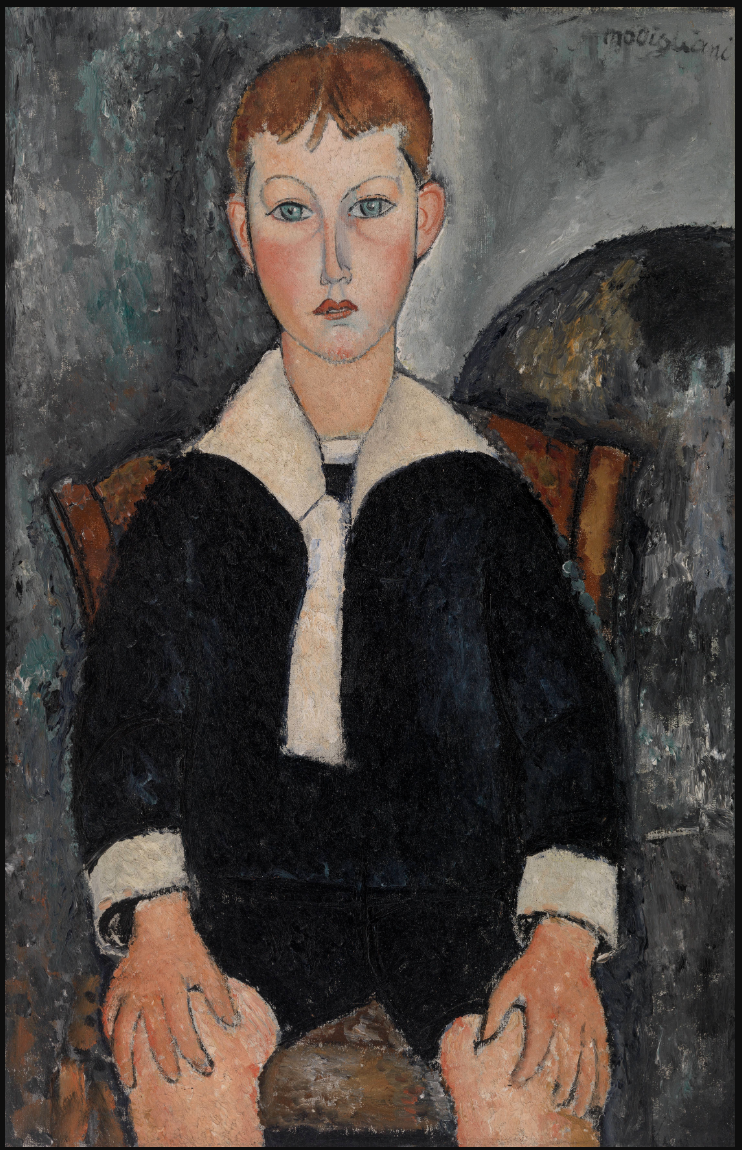
Fig. 1
Boy in Sailor Suit, 1917.
Barnes Foundation, Philadelphia.
Boy in Sailor Suit was among the first Modigliani paintings acquired by Dr. Barnes from Galerie Paul Guillaume by January 1923, making it among the first works by the artist to enter a U.S. collection.
May 10, 2026
The recently launched Amedeo Modigliani Digital Catalogue (AMDC) is the first interactive online catalogue dedicated to documenting the paintings of Amedeo Modigliani (1884–1920). It is not a catalogue raisonné rather it is intended as a scholarly resource, representing in-depth, fact-based research into Modigliani’s life and circle and strives to provide a greater understanding of his art.
Phase I of the AMDC is focused on paintings that were published in Ambrogio Ceroni’s authoritative catalogue that are in public collections in the United States. Represented by 59 paintings in 25 institutions located in 14 states, plus Washington, D.C., this is the largest concentration of publicly accessible Modigliani paintings in the world. [1] Many were imported from Europe by intrepid collectors and prescient art dealers in the 1920s when the American dollar was advantageously valued against the French franc.
Dr. Albert C. Barnes was the first to assemble a Modigliani collection, which began with two small drawings that he acquired from Galerie Paul Guillaume in Paris in August 1922. That year Barnes established his foundation in Merion, Pennsylvania, and in early 1923, a selection of works from his growing collection went on view at the Pennsylvania Academy of the Fine Arts in Philadelphia. Today the Barnes Foundation has one of the largest holdings of Modigliani paintings in the world (Figs. 1 and 2).
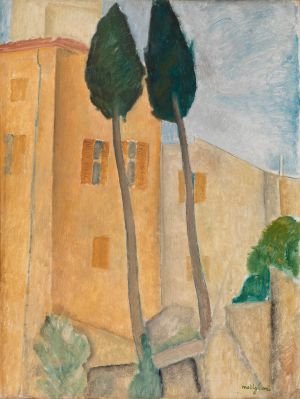
Fig. 2
Cypresses and Houses at Cagnes (Cyprès et maisons à Cagnes), 1919
Barnes Foundation, Philadelphia.
One of only four known landscapes by the artist, this painting was acquired by Dr. Barnes in January 1925.
Equally large is the Chester Dale Collection at the National Gallery of Art in Washington, D.C. Dale, a stockbroker in New York, began collecting modern art under the guidance of his wife, Maud Murray Dale, who had studied painting in Paris. They bought their first works by Modigliani in 1927 and, shortly thereafter, the couple became regular lenders to exhibitions across the country, as well as overseas (Fig. 3). In 1943, the modern works from the Dale collection, including seventeen Modigliani paintings, were divided and sent on loan to the Art Institute of Chicago and Philadelphia Museum of Art, where they remained until the early 1950s. Upon his death, Chester Dale bequeathed the entire collection to the National Gallery.
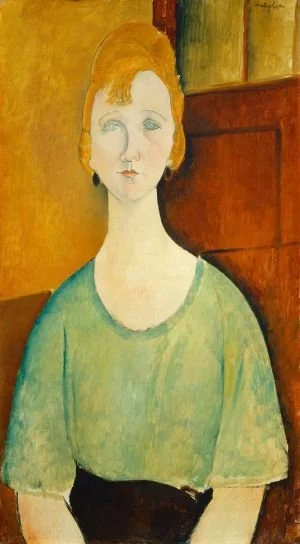
Fig. 3
Girl in a Green Blouse, 1917
National Gallery of Art, Washington, D.C. Chester Dale Collection.
Acquired on April 5, 1927, this was the first Modigliani painting to enter the collection of Maud and Chester Dale.
Established museums began acquiring Modigliani paintings through gifts and bequests in the mid-1920s. In Chicago, Helen and Frederic C. Bartlett assembled a small but extraordinary group of modern artworks, beginning in the early 1920s. In January 1926, shortly after Helen’s untimely death, Frederic Bartlett presented the Art Institute of Chicago with the Helen Birch Bartlett Memorial Collection. Including Modigliani’s rare double portrait of Jacques and Berthe Lipchitz, the collection catapulted the Art Institute into a leading center for modern art and the first museum in the country to own a painting by Modigliani.
Ada and William Preston Harrison, pioneering collectors in Los Angeles, bought their first Modigliani painting in Paris in 1927. That year they presented this early portrait, Reverie (Study for the Portrait of Frank Burty Haviland) to the Los Angeles Museum of History, Science, and Art (now known as the Los Angeles County Museum of Art; Fig. 4).
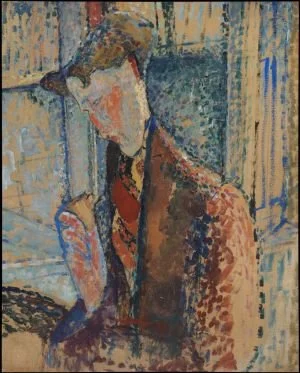
Fig. 4
Reverie (Study for the Portrait of Frank Burty Haviland), 1914
Los Angeles County Museum of Art. Mr. and Mrs. William Preston Harrison Collection.
Painted in the studio of his friend Frank Burty Haviland, this portrait may have been the first painting by Modigliani after he gave up sculpture in 1914.
The Museum of Modern Art in New York acquired its first Modigliani as part of the 1931 bequest of the Lillie P. Bliss collection. One of the museum’s founders, Bliss purchased the portrait of Anna Zborowska, the companion of the art dealer Léopold Zborowski, in New York in the fall of 1929, for her personal collection (Fig. 5).
Museums also took it upon themselves to add works to their permanent collections. Once again, the Art Institute of Chicago was first, acquiring Madam Pompadour, a portrait of Modigliani’s companion Beatrice Hastings, in March 1938.
In January 1939, in Buffalo, New York, the Albright Art Gallery (now known as the Buffalo AKG Art Museum) established a fund called the Room of Contemporary Art. The mission was to continue to add new art to the permanent collection and the works went on display on a rotating basis in this designated venue. Included in the Room’s inaugural display was the Modigliani painting, La Jeune bonne, which had recently been acquired.
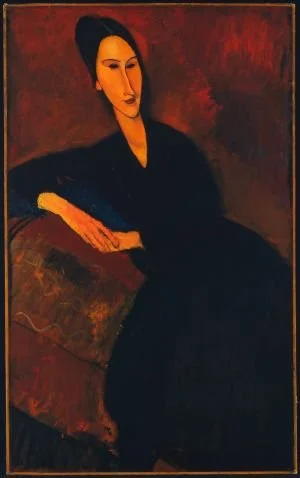
Fig. 5
Anna Zborowska, 1917
Museum of Modern Art, New York. Lillie P. Bliss Collection.
In response to collectors’ enthusiasm for Modigliani’s paintings, a number of New York art dealers began showing his artwork in 1929. The country’s first paintings retrospective took place that October at the eponymous gallery of César M. de Hauke, which was a subsidiary of the esteemed Jacques Seligmann & Co. A collaboration by de Hauke with Etienne Bignou of Paris and Alex. Reid & Lefevre galleries of London, the show featured thirty-seven paintings. Many of these were from the collection of Jonas Netter, a Paris-based collector, who was an early supporter of Modigliani. Netter amassed a large number of paintings and began selling works through this consortium of art dealers in the latter half of the 1920s.
Offering a snapshot of the Modigliani market in New York in October 1929, the art critic Henry McBride reviewed the de Hauke retrospective for the New York Sun:
"The money values of Modigliani mount prodigiously before your very eyes and the collectors who struggle for the best examples are now so numerous that these 'best examples' do not linger in dealers' galleries and are swept away into privacy before the general public has a chance to get acquainted with them." [2]
Suddenly, it seemed, Modigliani was everywhere in the United States. At the same time that the de Hauke retrospective was on view, Maud Dale’s monograph was published by Alfred A. Knopf as part of its series on Modern Art. Not only was this the first book on the artist to be written in English but it was also the first serious analysis of his work.
The explosive demand not only for Modigliani’s work but also for the School of Paris in late 1929 signaled the art market’s peak that occurred prior to the stock market’s collapse. Not long after, many collectors stopped buying art, which meant that a number of galleries were forced to close. This deeply impacted American artists and gave rise to a growing sense of nationalism and what became known as the “American wave.” In support of their countrymen, art critics scorned European artists and Modigliani became a target. In his 1934 book, Modern Art: The Men The Movements The Meaning, the conservative art critic Thomas Craven used the artist as his poster child, calling him a "gifted wastrel as a specimen of the effects of Bohemianism on the artist." [3] Craven illustrated his point with Dale’s Nude, for which the seductively posed model looks directly at the viewer (Fig. 6). Craven’s message reached a wide audience when Modern Art became a Book-of-the-Month Club selection and was sent to subscribers across the country.
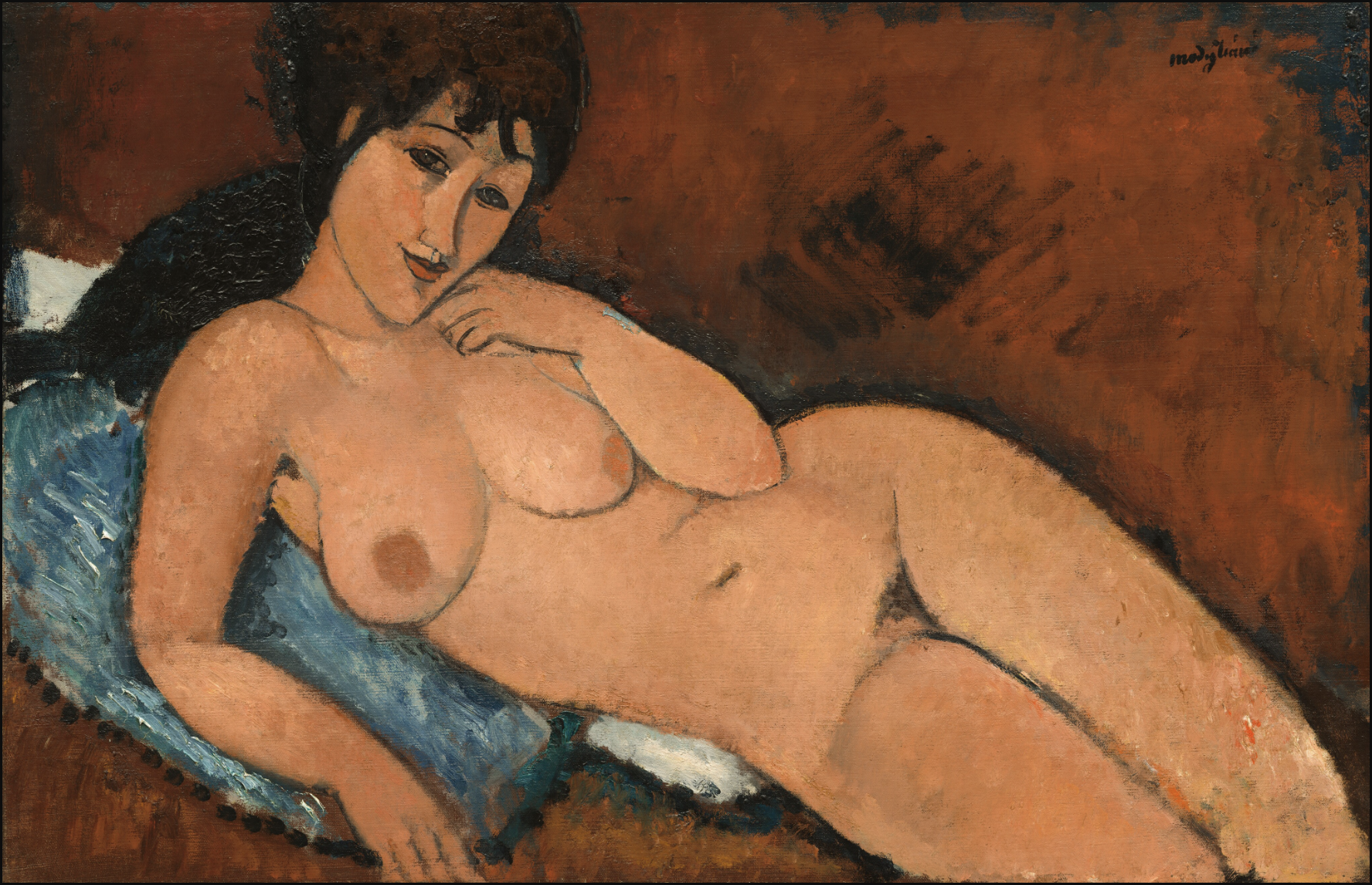
Fig. 6
Nude on a Blue Cushion, 1917
National Gallery of Art, Washington, D.C. Chester Dale Collection.
Nonetheless, exhibitions at museums and galleries continued to feature Modigliani’s paintings, culminating with the retrospective organized by the Cleveland Museum of Art and Museum of Modern Art, which took place in both cities in 1951. With over fifty paintings, a handful of sculptures, and a large group of drawings, this was the largest showing of the artist’s work to date.
In the ensuing decades, public institutions across the United States continued to acquire Modigliani’s paintings for their permanent collections. The most recent was the Henry and Rose Pearlman Foundation gift to the Brooklyn Museum just this year (Fig. 7).
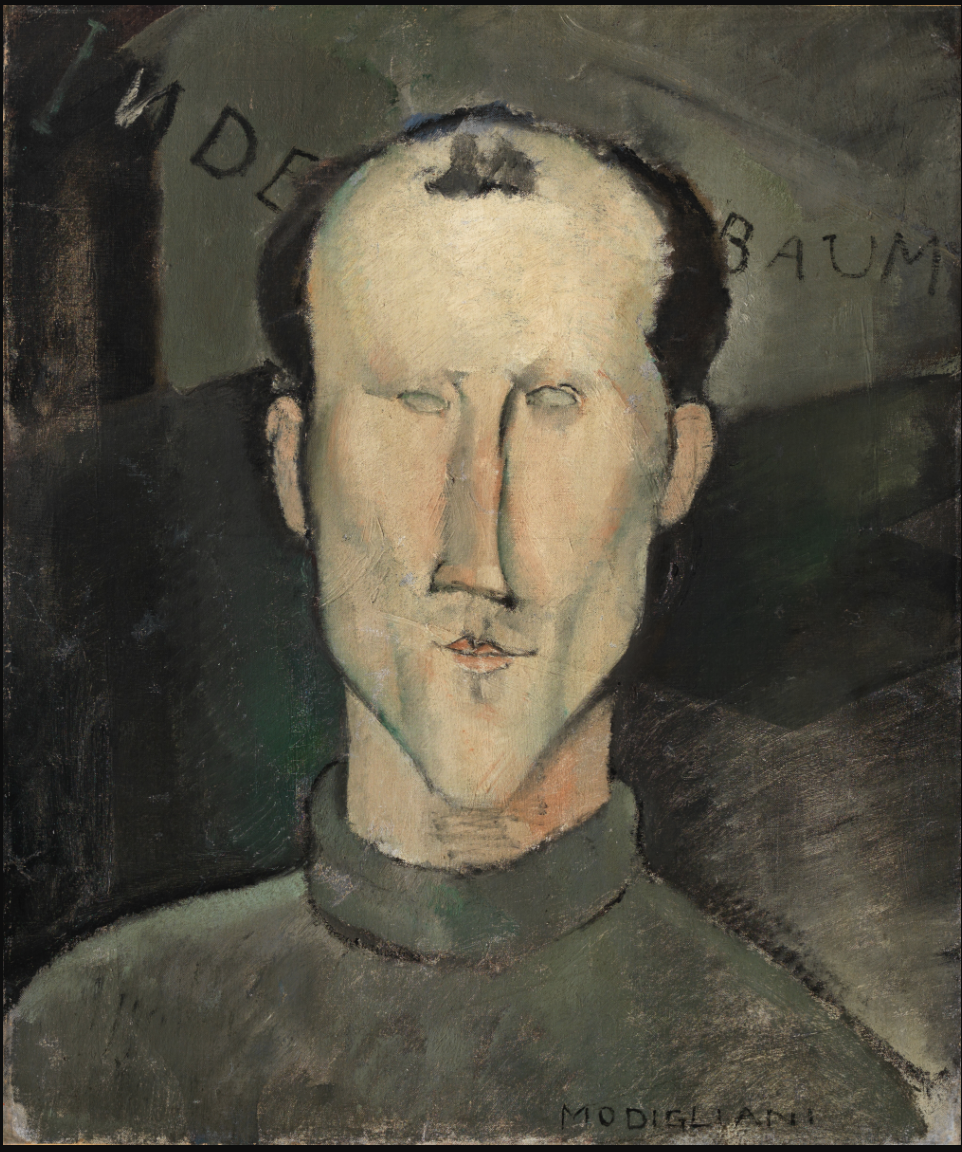
Fig. 7
Léon Indenbaum, 1916
Promised gift to the Brooklyn Museum from the Henry and Rose Pearlman Foundation.
The Modigliani Initiative
Endnotes
1. Ambrogio Ceroni, I dipinti di Modigliani (Milan: Rizzoli Editore, 1970)
2. Henry McBride, “Attractions in the Galleries: Modigliani's Tragic Fate Seen as a Potent Force in Establishing His Fame,” New York Sun (October 26, 1929): 10.
3. Thomas Craven, Modern Art: The Men The Movements The Meaning (New York: Simon and Schuster, 1934), ill. in b/w, n.p. (before p. 203).
The content presented on or through this website is made available solely for general information purposes. We do not make any representation or warranty as to the accuracy, completeness, or usefulness of this content. Any reliance you place on such content is strictly at your own risk. We disclaim all liability and responsibility arising from any reliance placed on the content by you or any other visitor to the platform, or by anyone who may be informed of any of its contents.